Monday, December 9, 2019

Nazareth, the next stop.


Our journey into Nazareth was a surprise.  One expected a desert-like location but it was a very busy city. The streets are filled with cars and very few people obeying the signs. They have some round a- bouts that really are aggression centers for cars to honk at each other. The streets are narrow and the sidewalks narrow too. The kids were getting out of school and they were everywhere.  There were many adults and it was a very crowded busy place.  The city we were in was a lot older than these more modern buildings in the photos.


Nazareth was the city in which Jesus was raised. Mary and Joseph had lived lived there before Jesus was born. They walked to Bethlehem to register their census and Jesus was born there.  For a while God sent them to Egypt, as King Herod wanted Jesus dead.  He wanted all one year old  boys to be killed to make sure Jesus would not survive. Being warned, Joseph took his family down and into   Egypt. Once Herod had died and the danger was gone, Mary and Joseph returned with Jesus to  Nazareth.

We visited an area in Nazareth where they recreated a typical city that represented the way life would be at the time of Jesus. You can see the contrast of this park in contrast to the city behind it.

Stables were represented where sheep and goats lived. The carved out area in the rock represented how they could keep their livestock safe while there was bad weather.


There were two donkeys at the recreated village. One was allowed to be out and tied to a tree.  The other one was used in the building where they crush olives into oil. The donkey would walk the stone roller around in a trough to crush olives for oil and to remove the seeds.  The donkeys are exchanged for  the duty throughout the day.

The photo to the side here is a gardener who is planting the field.


I am sharing a stray photo that I had of a sheep seeking hay through the poles.

This wagon looks like it would be useful to carry stone or crops.  I assume they used donkeys for this also as I am not certain if they had horses in the area two  thousand years ago.

The tree reminded me of a weathered olive trees at the Mount of Olives. It did fit in with the character of village.Everyone dressed in period clothing to help recreate the site.
This was described as a grape stomping area.  The juice would be ladled up from the low part of the rock bottomed area.

It looks like cabbages to me but I am not certain. It is an arid land so carrying water to the plants would be needed to keep them growing.
This is a building that was to be the future potters shack. They had a wheel and some pottery out to show its purpose. No potter has been hired to work in the shop. 
This man was a carpenter, Making wood items for the village. He made tools and spindles for wrapping wool yarn. The recreation showed how these items were needed  to help a community do household tasks.

Wooden bowls and spoons were essential at that time period of history.

This women was creating cords from wool of a sheep.  As she spin out wool she had to wrap it around spools.  Then she also was needed to weave the cords into cloth.

Spinning was done with a spindle twining the wool into a thin string for use on the loom.


A small temple was created to resemble one of the era. There were windows around the top to allow it to be lighted. The columns were made from stone and the floor was covered with stone. It is a dusty village so the stone floors appeared to have a coating of sand on them.


A Jewish village would have a temple in which to pray and also an altar for reading of the scrolls. This would be a strong structure compared to the use of maybe a tent when out in a desert setting. Two tiered seating was all along the outside walls. Oil lamps would have been used when more lighting  was needed.


As we left the tour we were give ceramic oil lamps that represented the one made in Jesus' time. Our bus leaves to take us north into the area  of the Sea of Galilee.Nazareth is in the district of Galilee.

Thursday, December 5, 2019

The Valley of Armegeddon.....

Mount Carmel was our next destination.

This is where Elijah defeated the worshipers of Baal with a fire challenge.

 Carmel means garden of God.


Mt Carmel is located in Northern Israel.  The city of Haifa is just north of them and it is Israel's third largest city.  The area where we visited was on top of a mountain over ooking a great valley.  Noted biblical persons walked up that valley including Jesus. and old testament persons.  It is the passage that everyone has to take to travel north or south.


This valley is identified as being Armageddon as mentioned in the old testament. That is identified as the site or time of a final and conclusive battle between the forces of good and evil.


While we were visiting on the balcony looking out, a Canadian tour group decided to sing a rousing praise song projecting music out to the valley. I read that their are caves along this valley journey where people sought refuge during hard times in the country.


On top of the hill next to the building with a balcony was a memorial spot where a Catholic priest built a garden.  It was decorated with many objects  from rocks. The area had a few stone rest benches where different tour groups could then sit and listen to the tour guide.


This scene shows a better view of a garden than the area where all the rock formations were displayed. The gardens are old as the trees were old. Built next to the balcony location area was also a gift shop and a small Catholic Church.


Elijah in the old testament was in this area.  This is the spot where he as a prophet was challenged by Baal followers. They challenged him to build an alter and ask his God to set it afire.  Elijah pointed out to them that they should do the same, praying toBaal to set their altar wood afire.  Elijah proceeded to have people throw buckets of water onto his wood.  God did set his altar wood afire and the worshipers of a log stuck in the ground did not get the job done.


The historic site is controlled by the Catholic Church so they posted signs of direction to the visitors.

As I am writing these posts, I find that I have to research things to be sure that I am sharing things that I thought I had heard from the tour guide. I do want you to know that as I learn new things, I do go back and edit.  The post is for sharing the photos first but identification the place and history comes in a good second.

Tuesday, December 3, 2019

Heading North up the Coast......

Caessarea is a costal city created by Great King Herod as he was wanting to have a great  sea port.  He built a palace there next to the coastline of the Mediterranean Sea. The area was built around 15-11 BC. It was in the king's hands when it fell to the Muslims hundreds of years later.  The Crusaders drove the Muslims later from the area.  It kept changing ownership and  a Jewish Kibbutz resettling the area after the war of 1967. 


As we traveled north to get to the city we saw stone walls with flowers decorating along the highway.  I really did not have a clue as to what we would find when we first arrived.


The first walls we saw gave us an indication that the three thousand year old city had been restored. You could see that some bricks were reset into place.


Wild life did entertain the tour as he sat up on the rock sunning himself. That was the extent of wild life in the area and yet there were many birds calling from the palm trees.


As we approached the city, things didn't look so exciting.  Though this was old ruins I didn't have a clue what we were about to see. Jesus had been on this site many times as describe in the scriptures. Paul also visited the area later on getting himself in trouble for preaching Christianity.


There were tunnels that we walked thorough as we walk down paths behind the first set of ruins. The Roman arches were used as the Roman king and his people that occupied the area had built the things in the way that they were use to seeing in Italy.


Walk ways helped the people to see the ruins of the city in the area as we were able to walk over them.


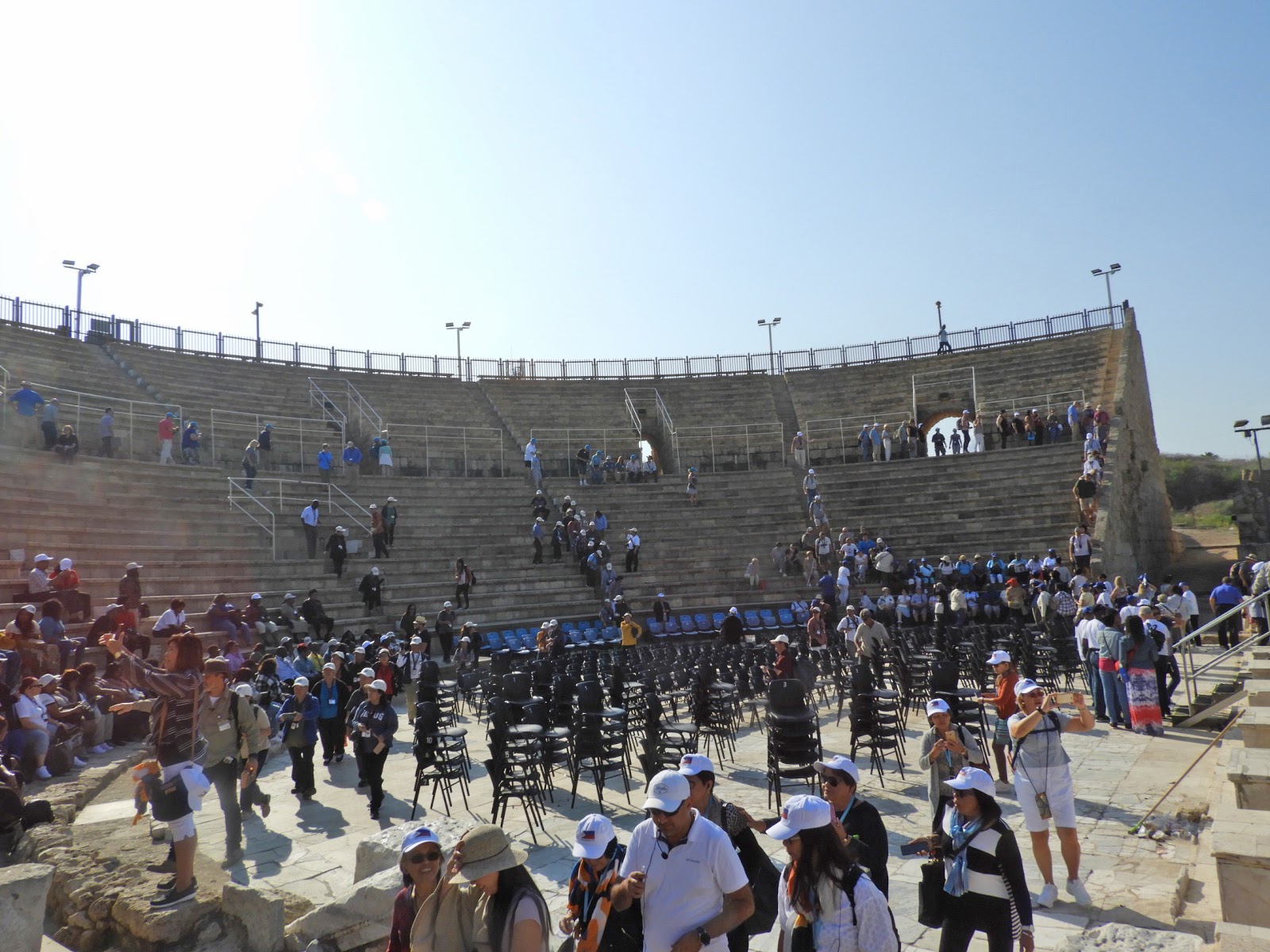
As we wandered through the tunnels we were surprised when we walked down some stairs. We were to see the three thousand plus years  old coliseum, that seated a thousand of people or more.  I did see that they still hold concerts here today with the area filled with people and folding chairs filling in the rest. There are light poles installed on the back of the stairs.  It was mentioned that Paul from the New Testament preached here.


Paul did preach here and he was eventually sent to Rome to be killed. He preached the gospel and was rejected by the higher powers that were in charge.


The King's palace was built on the edge of the water. It was amazing to see all the foundations and floors of this building. It did look like a rich man's summer home where the breezes from off the sea would make for great living on very hot days.


A hippodrome was also built down the way in the above photo.  Fighting battles between men would be held there as well as fighting animals. It looked closer to one of our football stadiums with only one side for bleachers. .


The evidence of mosaic tile floors were scattered throughout the ruins.


This is the evidence of the Muslims having overtaken the area and controlling that part of the coastline.


I could imagine that many people used the beach for bathing and I am sure fishing took place along the whole coastline. King Herod did have a channel build to transport fresh water from 10 km away.


A borrowed photo from the net shows the sections of the aqueduct that still stands today. We drove by the place but didn't get good pictures.


Our journey on will takes us tto Mr. Karmel. There old testament history is remembered and the Armaggedon valley can be viewed.


Sunday, December 1, 2019

Our First Night in Israel.....


Our very long flight from Chicago over the Arctic Circle did end in Istanbul, Turkey.  From there we took a short hour or so long flight into Israel.  Ben Gurion Airport was actually in Yagel, Israel.  We had our tour bus waiting there for us to start our tour.  The impressive buildings of Tel Aviv were modern and tall.  They were either apartment buildings or business building. The photo shows the beginning of what was miles of buildings. 


This is a borrowed view of Tel Aviv. As we traveled by the area in the dark I didn't get photos. I was so impressed with the large area of very tall buildings. Israel has really invested into the development of this modern city. There is an older town areas but the interstate drove through so many buildings on each side.

Our first hotel was in Netanya.  Just like Tel Aviv, we were on the Mediterranean Sea.

Netanya was full of many hotels for tour groups. This is the view from hotel room. Tourism is Israel's number one industry in their country. People from many nations all over the world visit the country.

The smaller buildings below were a mystery to me but I think they were houses or apartments.

The parking lot suggested it could have been a business. The stucco building did blend in with climate.


Looking east the sun is rising and you have more light to see the row of palm trees bellow. The balcony is one of another room, not ours.

The sun rise in the east and I did figure out that I was confused as to where the Sea was located. The sun comes up in the east, duh.


The view of the Mediterranean was fantastic and the clouds are being lighted by the sun opposite of them.

The flowers are not natural but they do look like the are blooming where they are planted.  It the photo above you can see these same flowers.


This is one of my last shots before we crossed the street to board the bus.  Little did we know what great things we were going to see at our first stop at Caesarea, Israel.

As I blog I do try to keep the facts correct. I can make mistakes but I am trying to research as I go.